
Exponentially Improve Your Financials with a Risk Management Maturity Journey

Construction projects are becoming more complex in nearly every way: tighter schedules, more sophisticated building systems, increased labor coordination challenges, rising material costs, and greater pressure from owners and lenders to keep projects on track. At the same time, the financial impact of water-, fire-, and security-related losses continues to grow.
The construction industry now has access to more risk mitigation technology than ever before. Sensors, automated water shutoffs, environmental monitoring, and real-time alert platforms can identify issues faster and limit damage before it escalates into a major claim. Yet, despite the proven positive impact of Internet of Things (IoT) technology, adoption across the industry still lags. According to KPMG International's Global Construction Survey 2025/2026, only 43 percent of general contractors report adopting risk monitoring tools.
The hesitation is understandable. Implementing IoT technology successfully is not as simple as purchasing devices to place around a jobsite. It requires operational changes, defined response protocols, internal accountability, and a clear understanding of how the technology fits into existing workflows. For many organizations, the challenge is not whether the technology works but understanding how to realistically integrate it into their business.
This is where maturity becomes important. Organizations do not deploy fully predictive risk management systems overnight. There are distinct stages of adoption, each with different operational requirements, financial impacts, insurance implications, and expected outcomes. More importantly, each stage changes where intervention occurs in the loss life-cycle. The earlier a company can identify and respond to an issue, then the greater the reduction in claim frequency, claim severity, project disruption, and overall financial exposure.
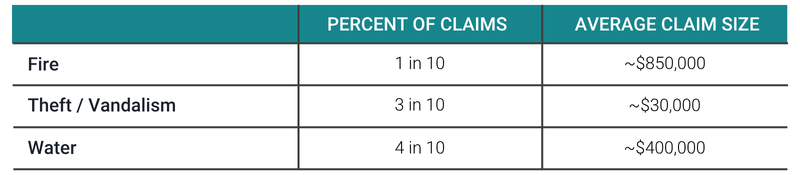
As a brief discussion on claims and why maturing risk management is so important, below are the frequency and average size of the most prevalent and/or destructive claims for builders risk projects. Almost 80 percent of claims fit these categories and can be better mitigated through the adoption of IoT technology and sound risk management.
In this article, we will examine the five stages of the Risk Management Maturity Journey for water-, fire-, and security-related construction risks. You will learn the following.
- How to identify which stage your organization currently operates within
- The operational characteristics and trade-offs at each stage
- How IoT technology impacts claim frequency and severity
- The relationship between maturity level and insurance pricing
- The realistic costs required to transition between stages
- The benefits and hurdles that organizations commonly face during implementation
The goal is not to position IoT technology as a silver bullet. Instead, the objective is to provide a realistic framework for understanding how organizations mature their risk management programs over time and how those decisions can materially improve project outcomes and financial performance.
The Maturity Framework At A Glance
Each general contractor typically fits into one of five stages when it comes to IoT utilization for preventing water-, fire-, or security-related risks. These stages range from having no formal controls in place to fully integrating sensor data into portfolio-level operational and financial decision-making.
The table below summarizes the characteristics of each stage. Estimates are based on construction-specific water damage benchmarks from WINT, Munich Re, and KPMG International's Global Construction Survey 2025/2026.
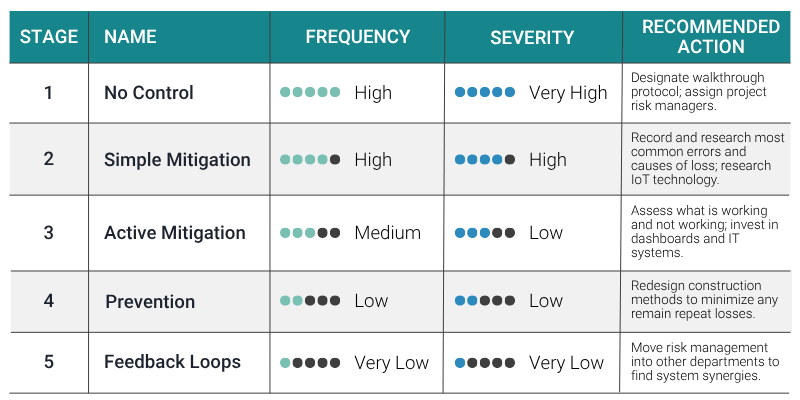
The most important takeaway from the framework is that the financial benefit increases exponentially as organizations intervene earlier in the loss life-cycle.
At lower maturity stages, losses are discovered after damage has already occurred. As organizations move up the maturity curve, technology enables earlier detection, faster response, automatic intervention, and eventually predictive analysis. Each transition meaningfully reduces expected annual loss costs by 5–10 times, but only when the investment is deployed properly and supported operationally.
Details Of Each Maturity Stage
To identify where your organization currently sits within the Risk Management Maturity Journey, it is important to understand the operational characteristics, limitations, and financial implications of each stage.
Stage 1: No Control
- Overview: With no formal risk management in place, loss events are discovered after the fact, running unchecked for hours or even days.
- Common Scenarios: Because nothing is preventing or limiting exposure time, projects experience fully flooded buildings, mold remediation, or structural damage from water infiltration, adding weeks or months of delays to an already-packed project schedule.
- Expected Consequences:
- Highest Insurance Rates In The Market. Insurers anticipate adverse development and price accordingly.
- Reputational Impact. The negative perception from owners, lenders, and surety companies follows the organization for years.
- Contractual Exposure. General contractors can anticipate renegotiations, liquidated damages claims, and potential litigation.
- Safety Hazards. Structural compromise, slip/fall, and electrical exposure in wet environments add further exposures.
Stage 2: Simple Mitigation
- Overview: Basic human-driven detection is introduced, such as regular inspection rounds, designated safety officers, and manual documentation of issues. While an improvement from Stage 1, companies operating at this level are still reactive to identifying loss events.
- Common Scenarios: Detection happens manually: a leak discovered during an inspection round or a subcontractor notices discoloration on a ceiling. Response is initiated by a human making a judgment call.
- Expected Consequences:
- Issues can occur minutes after an inspection or the last worker leaves for the evening, allowing water to seep into framing, insulation, drywall, mechanical components, and concrete.
- Human detection creates a false sense of security; it does not meaningfully stop damage from occurring.
Stage 3: Active Mitigation
- Overview: IoT technology enters the risk management equation with deployed sensors transmitting data to a monitoring platform, generating alerts that are routed to designated responders.
- Common Scenarios: A water-flow meter alerts to a sudden rush of water that is beyond any level of open faucets, indicating a broken line. A motion detection sensor shows there is an animal (or person) in your project site at midnight. A rate-of-rise device lets you know when the temperature in a hot-work area has risen to levels indicating a fire.
- Expected Benefits:
- Significantly Improved Project Timelines. Water events no longer mean weeks of remediation.
- Labor Utilization Improvement. Workers are not redirected to emergency cleanup or laid off due to water-caused delays.
- Process Improvements. Data analysis of all alert events creates a documented record of near-miss events and trend patterns, insights that can be incorporated into existing processes.
- Improved Satisfaction. Customer and lender satisfaction improve as project predictability increases.
Stage 4: Prevention
- Overview: Automatic intervention is driven by IoT technology. Technology not only identifies developing problems but also initiates predefined actions designed to stop or limit damage.
- Common Scenarios: A shutoff valve can be set to the "off" position every night and weekend, which would prevent the largest losses. Building heat can be activated to prevent frozen pipes if a temperature sensor detects dropping temperatures past a set threshold. A 24-hour heat monitor can be placed at any hot-work location to monitor for climbing temperatures. Human interaction can now focus on minimal cleanup and investigation into the cause.
- Expected Benefits:
- Dramatically Lower Insurance Premiums. Insurers recognize the impact that automated IoT technology makes on reducing claims severity.
- Reduced Labor Costs. Automated response eliminates emergency call-out fees and overtime for after-hours incidents.
- Subcontractor Accountability. Automatic shutoffs remove ambiguity about when water was stopped and who was responsible.
- Defensible Claims Record. Time-stamped sensor data, alert logs, and automated response records are powerful in subrogation and dispute resolution.
Stage 5: Feedback Loops
- Overview: Integrating sensor data into predictive analysis and portfolio-level risk management allows patterns to be identified across multiple projects, such as weather conditions and related moisture events or repeated alerts from specific sensor zones. These are then fed back into project planning, procurement decisions, and contractor qualification criteria.
- Common Scenarios: Predictive maintenance replaces a worn part before it fails. Temperature sensor patterns across a portfolio reveal that a particular mechanical room configuration consistently approaches freezing conditions, triggering a design modification for future projects.
- Expected Benefits:
- Best-In-Class Insurance. This stage presents the strongest option to achieve best-in-class terms, with some builders risk programs offering premium reductions of 25–30 percent for fully instrumented, Stage 4/5 deployments.
- Portfolio-Level Insight. Patterns across 50-plus projects drive estimating, scheduling, and subcontractor selection.
- Competitive Differentiation. Increasingly, owners and general contractors with sophisticated risk management track records access better bonding capacity and lower insurance costs.
How IoT Technology Reduces Claims
One of the most important distinctions in evaluating IoT technology for construction risk is first understanding its scope and what it can or cannot prevent.
IoT is not a universal loss prevention tool. It excels at detecting and responding to certain types of loss events, has partial effectiveness on others, and has no meaningful impact on claims driven by natural disasters or faulty workmanship. Misunderstanding these limitations often creates unrealistic expectations and frustration during implementation.
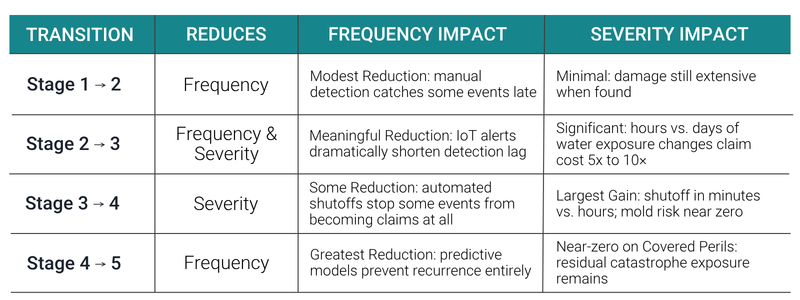
The graphic below maps common builders risk and construction claim types caused by water-, fire-, and security-related sources to three outcome categories based on IoT deployment stage. Stages 4 and 5 are grouped together as they both involve more advanced IoT usage, while Stages 1 and 2 are also grouped together for their lack of IoT investment.
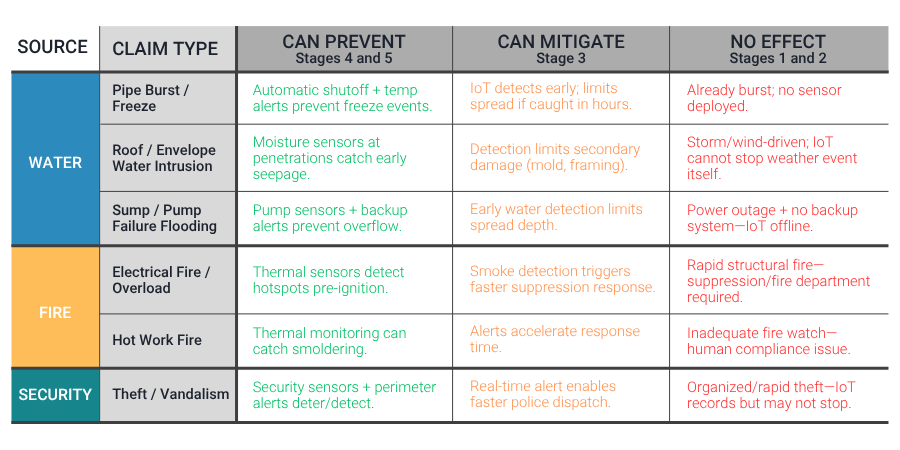
Understanding these limitations also clarifies how IoT affects insurance losses financially. IoT technology improves total claim cost through two distinct levers: frequency reduction and severity reduction. It is important to understand which lever dominates at each stage. This is critical for quantifying return on investment (ROI) and negotiating insurance terms.
- Frequency reduction. Fewer claims occur because problems are detected and addressed before they cause reportable damage.
- Severity reduction. When claims do occur, the damage is smaller because detection and response happened faster, such as within minutes rather than hours or days.
The relationship between water exposure time and claim cost is nearly exponential. The size of a claim from a project where a pipe runs for 30 minutes is vastly different from the same pipe running overnight. Studies from WINT and similar IoT technology providers suggest that automated shutoff systems can reduce average water damage claim costs by 60–80 percent compared to detection-only systems. This is why the transition between Stages 3 and 4 often creates the largest measurable financial improvement.
How Maturity Impacts Insurance Costs
Insurers evaluate construction risk using expected loss cost (ELC), which is calculated as ELC = Frequency × Severity.
As organizations progress through the maturity stages, IoT technology begins reducing both variables simultaneously. At lower stages, organizations experience both frequent and severe losses. As maturity improves, issues are identified earlier, response times accelerate, and automatic intervention reduces the scale of damage. The result is that financial improvement becomes multiplicative rather than simply additive.
The following example illustrates this with a hypothetical midsize general contractor running 50 projects per year.
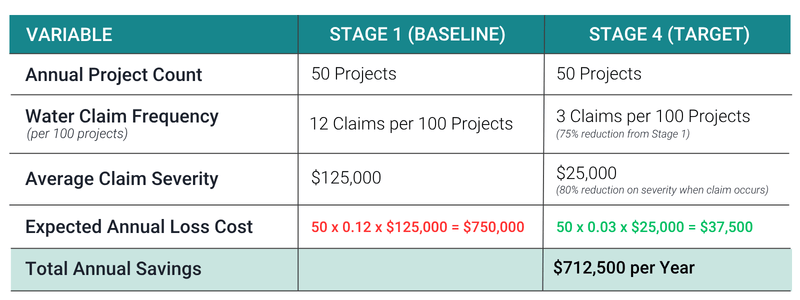
These illustrative estimates help outline the potential impact of technology on rates. Actual savings will vary by project type, geography, sensor density, and response protocol quality. However, the framework itself mirrors the same methodology that insurers use to evaluate accounts. Increasingly, insurers are also incorporating IoT-generated data directly into underwriting conversations, particularly for organizations operating at Stages 4 and 5.
This explains why maturity matters beyond individual project protection: Stronger controls and documented response capabilities can materially improve on how insurers evaluate an organization's overall risk profile.
Realistic Transition Costs: What It Actually Takes
One of the most common failures in IoT adoption is underestimating the total cost of ownership. While hardware costs can easily be obtained, the financial aspects of the people, processes, and integration costs cannot. The table below outlines realistic estimates to transition from one stage to the next, including technology, installation, full-time equivalent (FTE) commitment, and ongoing annual cost.
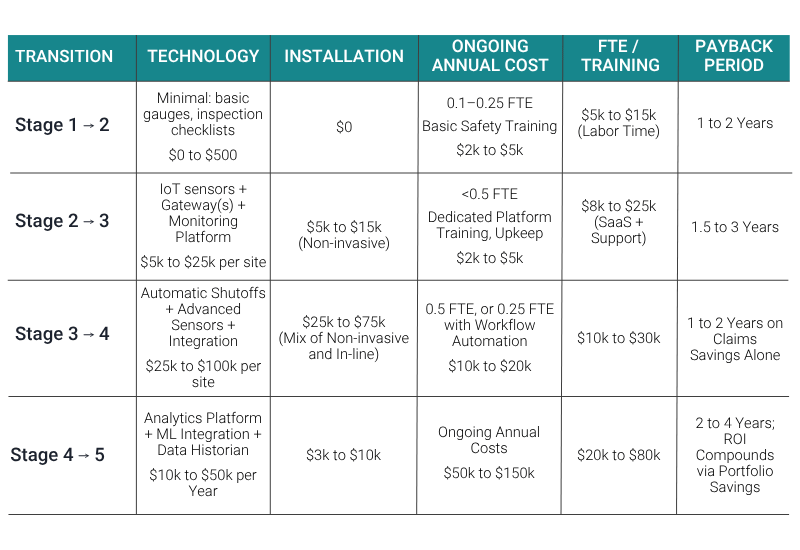
The shown costs in this chart are estimates per active project site for technology/installation and portfolio-level for FTE and annual platform costs. These numbers will adjust based on project count, project size, and geographic complexity.
Based on our experience with hundreds of projects, there are specific transitions where costs tend to exceed expectations.
- Stage 2 → 3: This transition is often underestimated; the SaaS platform, connectivity infrastructure, and alert response workflow can cost more than the sensors themselves. General contractors should budget for integration and recurring training; adoption and response training are required to see any benefits.
- Stage 3 → 4: Licensed tradespeople are required to install automatic shutoffs in most jurisdictions. This is not a self-install upgrade, so plan for contractor involvement and permit requirements. Many systems have smartphone-enabled shutoff valves, which means a central person can oversee many projects.
- Stage 4 → 5: The jump to predictive analytics requires either a vendor platform built for construction data or internal data engineering capability. Off-the-shelf IoT platforms rarely support this out of the box without significant customization.
- Across all stages: Training and change management are underbudgeted consistently. The technology does not work if field teams do not trust it, use it correctly, or respond to it appropriately.
Benefits And Hurdles To Prepare For
It is easy to view IoT technology as a solution that immediately eliminates project risk. In reality, successful implementation requires operational discipline, organizational buy-in, and realistic expectations.
The included chart is based on feedback from actual IoT customers and highlights both the measurable benefits and common hurdles that organizations encounter during adoption.
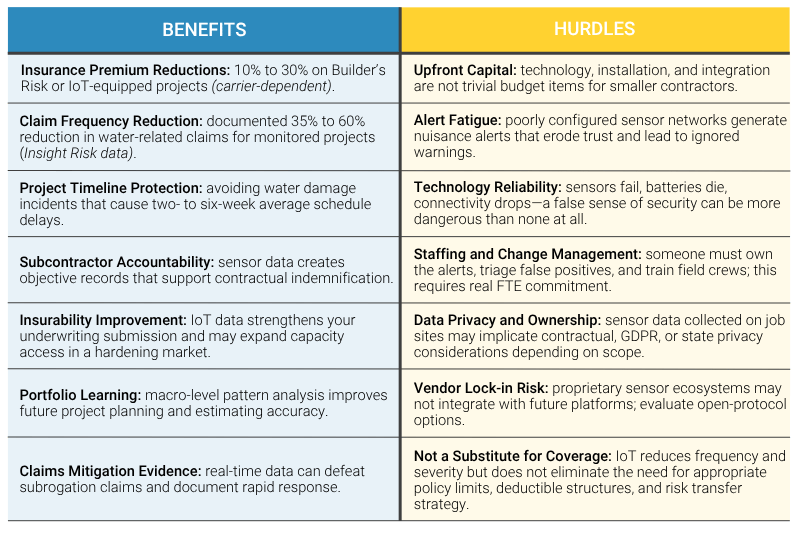
Out of all stages, Stage 3 is the one that teams have the most difficulty with, as it is entirely dependent on the quality of the human response loop. If alerts go unacknowledged due to alert fatigue, poor escalation protocols, or staffing gaps, the technology provides data without action. Many contractors stall at this stage because they underestimate the operational change management required to support the technology.
Preparing for these hurdles and specific stage issues helps teams achieve significantly better long-term outcomes. While a general contractor may target achieving Stage 3 or 4, implementing to full maturity at Stage 5 brings exponential benefits. As buildings grow increasingly more complex and infrastructure ages, facility teams and project managers are finding that traditional maintenance approaches are not sufficient. The feedback loop stage provided at Stage 5 is where IoT investment transitions from a risk management tool into a strategic business asset.
The Last Word
Every stage transition for the Risk Management Maturity Journey delivers a measurable financial benefit. However, those benefits are not driven by utilizing sensors alone. This is not simply a technology deployment exercise; it is a business transformation that requires organizational commitment, proper deployment, and sustained engagement with ownership, boards, site teams, and insurance partners.
Expectations should be clearly defined from the beginning. Stakeholders across ownership groups, operations teams, insurers, and project leadership need to understand both the opportunities and the limitations of the technology. IoT technology works best when it enhances existing risk mitigation practices rather than attempting to replace them.
Organizations with the most mature risk management strategies are typically the ones achieving fewer and less severe losses, stronger insurance submissions, improved underwriting outcomes, better access to capacity, greater owner and lender confidence, and more predictable project execution.
The general contractors who realize the full ROI from IoT technology are not the ones who purchase the most devices; they are the ones who built the internal processes to respond to technology. The question now is whether organizations will move proactively through the maturity stages—or wait for a multimillion dollar water claim to force the conversation.
*This article was first published on IRMI.com and is reproduced with permission. Copyright 2025, International Risk Management Institute, Inc.
At Insight Risk, we help protect commercial ground-up and renovation projects at every stage, combining expert underwriting with proven IoT solutions to prevent water losses before they happen, safeguarding your schedules, your budgets, and your hard-earned reputation. Contact Insight Risk today to discover how our White Glove IoT Risk Tech solutions can safeguard your next adaptive reuse project from Day One.
Other Blogs You May Be Interested In